

With graduation season right around the corner, many soon‑to‑be college grads are once again asking a familiar question: Will I be able to find a job?
That anxiety is understandable. Last summer’s bump up in unemployment among recent college graduates was viewed by some as a sign that AI was beginning to shut young workers out of the labor market.
In my previous post on this topic, I argued that the rise in unemployment for young, college-educated workers looked more like a seasonal spike than a structural break. Graduation season always brings a wave of new entrants into the labor market, and that predictable influx tends to push up unemployment temporarily among 20‑ to 24‑year‑olds with a bachelor’s degree. In other words, given the data available at the time, it looked like “a familiar seasonal pattern, not a white‑collar recession.”
Advances in AI may eventually impact the entry‑level labor market, but it hasn’t happened yet in a way that is visible in aggregate unemployment data. With more data points now available, last summer’s sharp rise in unemployment among recent college graduates looks less like the beginning of a sustained deterioration and more like what it probably was all along: a predictable summer spike that has since largely waned.
Unemployment Has Fallen Sharply for Young Workers
The unemployment rate for 20‑ to 24‑year‑olds rose into late summer and early fall of 2025, which helped fuel commentary about AI beginning to hurt the job prospects of young workers. But with several more months of data now available, that interpretation looks much less convincing.
The unemployment rate for young workers has fallen markedly from its highs last summer, while the overall unemployment rate has remained relatively stable (Figure 1). In fact, the unemployment rate for 20‑ to 24‑year‑olds now sits at its lowest level in more than two years. The gap between the overall unemployment rate and the unemployment rate for 20‑ to 24‑year‑olds has also narrowed considerably since last summer and is now at its smallest level in more than two years.
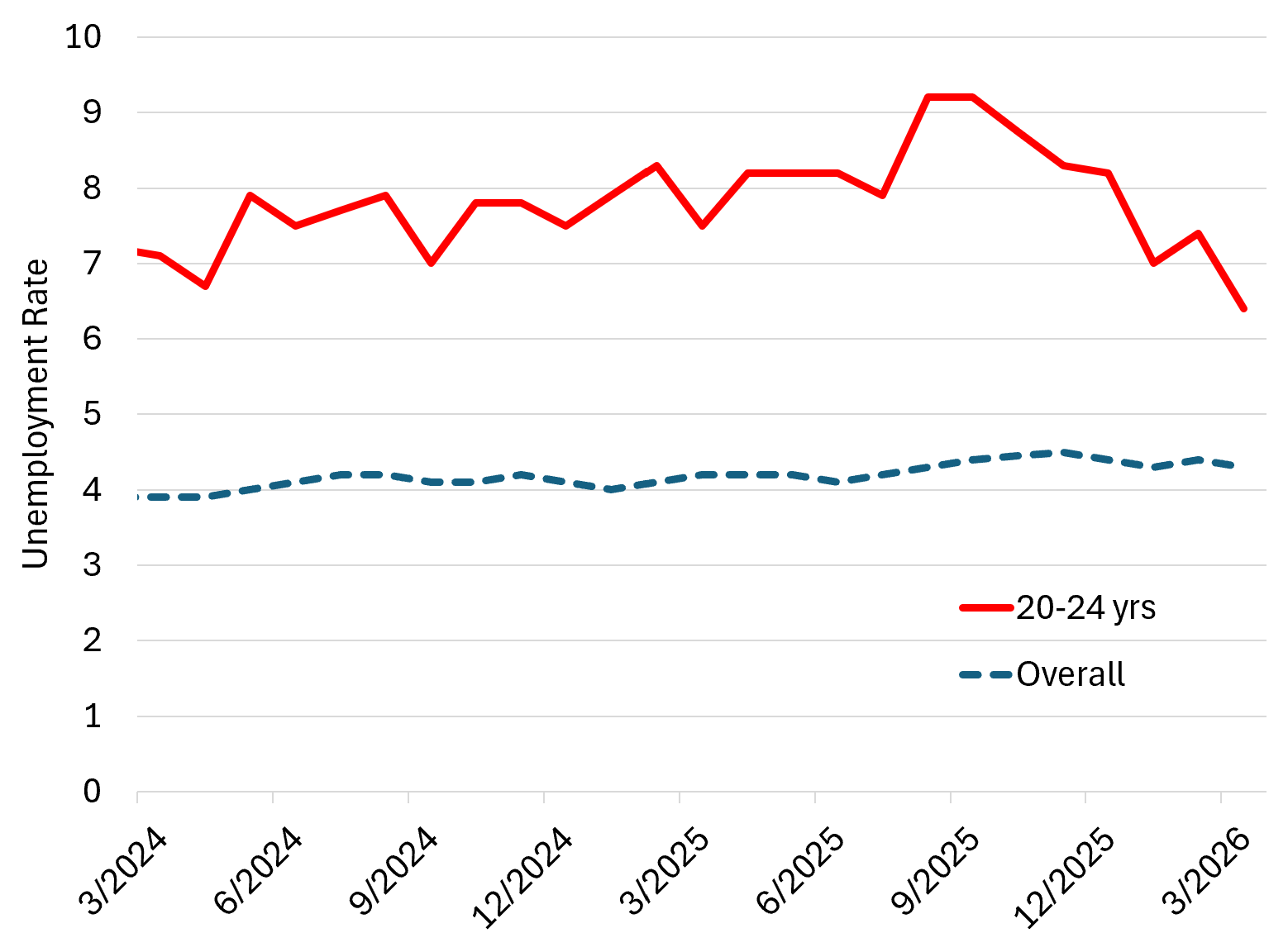
For students graduating this spring, these trends should be at least mildly reassuring. Based on the aggregate data, the job market has not suddenly become inhospitable to young workers. In fact, the data suggest that young workers are doing better relative to the overall labor market than at any point in the past few years.
Last Summer’s Spike Was Most Likely Seasonal
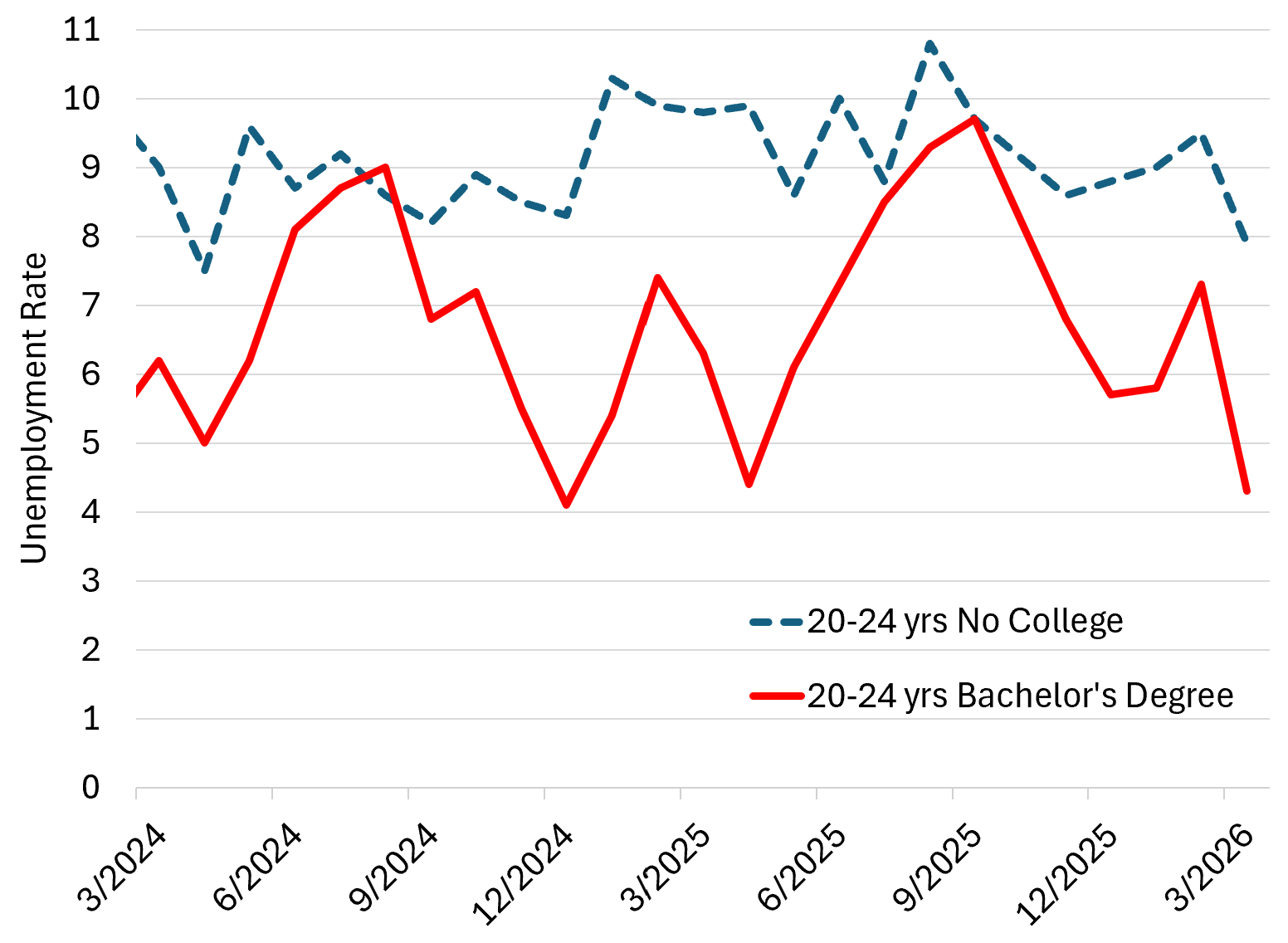
The more relevant measure, however, is the unemployment rate for recent college graduates. Here too, the new data fit the same pattern: last summer’s spike was most likely just a typical seasonal fluctuation. As Figure 2 shows, the unemployment rate for 20‑ to 24‑year‑olds with a bachelor’s degree rose markedly last summer and then came back down sharply in the fall and winter, just as it has many times before. Last summer’s increase was thus likely just a predictable seasonal pattern rather than a lasting deterioration in the job market for recent college grads.
That does not make last summer’s spike in unemployment meaningless. For those who graduated into what was a particularly congested labor market, it might have felt very real, like something permanent had changed. It is hard to maintain objectivity when you are the one living through it: sending out countless applications, waiting for responses, and watching friends land jobs. Starting a career is stressful even in good times, and headlines filled with stories of AI-related layoffs likely amplified that stress. But based on the aggregate data, it looks like the labor market for new college grads is largely behaving as expected.
The comparison with similarly aged workers without a college degree is also revealing. In my earlier piece, I pointed out that the unemployment rate for recent college graduates can sometimes rise above that of similarly aged workers without college degrees during the summer months, precisely because so many graduates are entering the labor force at once. But that reversal tends to be brief: by the fall, college graduates usually have a lower unemployment rate than their less‑educated peers.
As we can see in Figure 2, that same pattern played out again last year. As of this spring, 20‑ to 24‑year‑olds with a bachelor’s degree once again have a meaningfully lower unemployment rate than similarly aged workers without college degrees. If the labor market were becoming hostile to recent college graduates, this is not what one would expect to see.
The Gender Split Looks Less Alarming Too
As I argued in my earlier piece, last summer’s spike in unemployment among recent college graduates seemed to be driven more by men than by women. While male unemployment in this age and education group is generally noisier and tends to be higher than female unemployment, both series have declined markedly from their highs last summer, as shown in Figure 3.
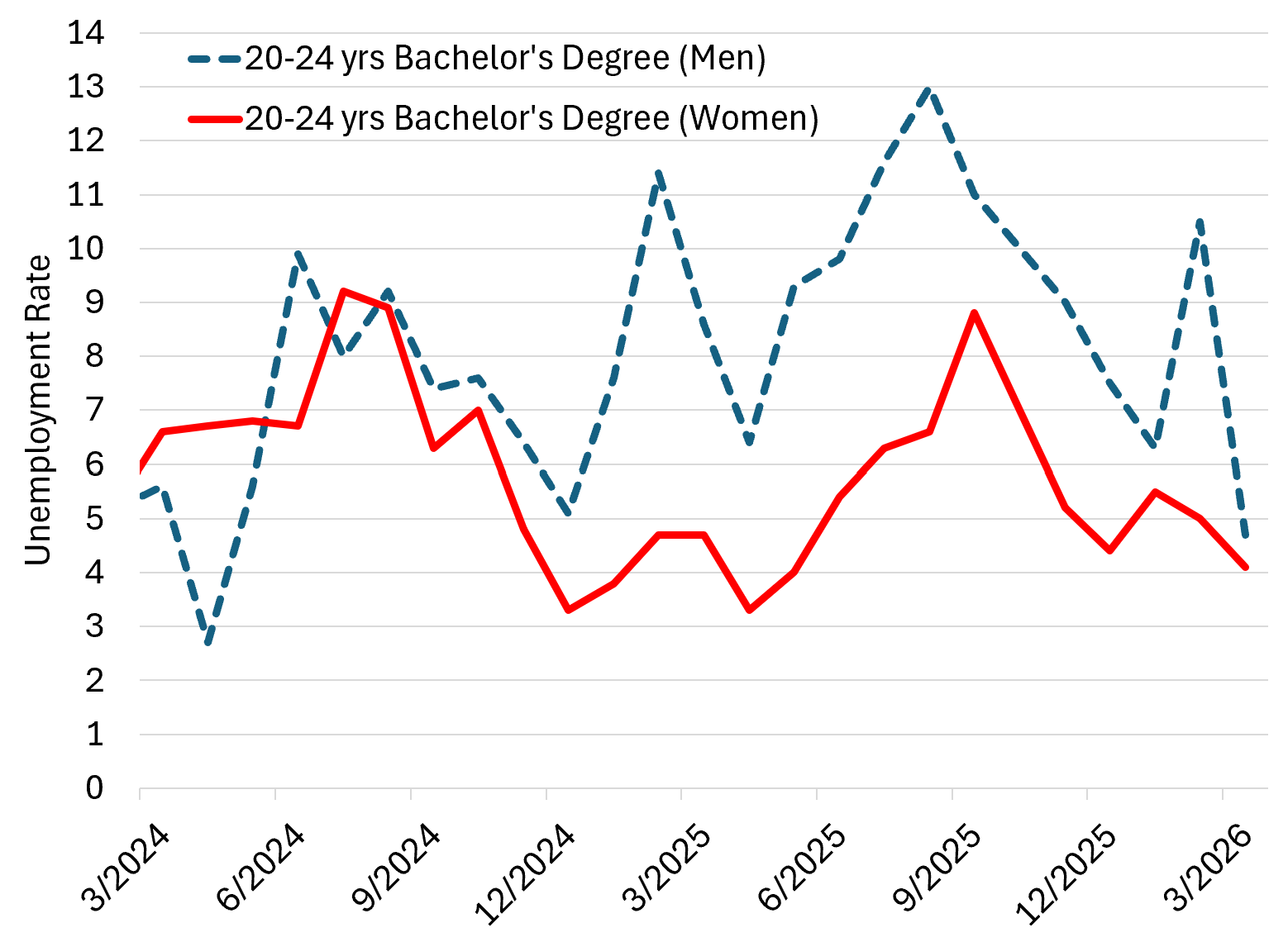
Thus, even for the subgroup that was most affected by the rise in unemployment (male, recent college grads), the data do not point to mounting distress. If anything, they suggest the opposite: the worst of the unemployment spike has faded, and the gender gap has narrowed considerably.
Putting It All Together
If AI is already taking a meaningful bite out of job opportunities for new college graduates, it is not yet visible in aggregate unemployment data. The job market for recent college graduates appears to be holding up reasonably well. Last summer’s spike in unemployment appears to have been a predictable seasonal fluctuation, not the beginning of a secular deterioration in the job market for entry-level workers.
For the Class of 2026, this does not guarantee a smooth transition into the job market. Some will still struggle to land their first job, and for them the search may feel every bit as discouraging as the headlines suggest. But based on the aggregate data available today, while it is possible that AI may eventually impact the employment prospects of new grads, it is not visibly weakening the labor market for young workers in the way some have argued. If anything, the data suggest that job prospects for the Class of 2026 may be somewhat better than they were for the cohorts that preceded them.
More broadly, this is a reminder that economic narratives are often built on a handful of observations that happen to arrive at just the right time. Plausible stories about how AI may affect us in the future are not the same thing as evidence that it is impacting us today. And when fluctuations in the data are highly seasonal, as is the case for the unemployment rate of recent college grads, this piece demonstrates that a few more observations can make the difference between accepting a compelling narrative and getting an accurate interpretation of the data.
If you enjoyed this mildly efficient and occasionally rational update on the labor market for recent college grads, consider subscribing below. We’ll keep exploring markets and models, uncovering mildly surprising truths along the way.
No hot takes; just thoughtful ones.

About the Author: Seth Neumuller is an Associate Professor of Economics at Wellesley College where he teaches and conducts research in macroeconomics and finance. He holds a Ph.D. in economics from UCLA. His Substack is Mildly Efficient (and Occasionally Rational) where he explores topics in finance and macro from first principles, cutting through complexity with clear, grounded analysis.
Notes and Sources
AI tools were used to edit prose; all figures are straightforward to reproduce from the cited sources.