

Long-term Treasury yields have risen sharply over the past year. The yield on 10-year U.S. Treasury notes is now above 5 percent, its highest level since 2007. For bond investors, particularly those who are still rattled by what happened in 2022, this is unwelcome news.
The concern is understandable. Bond prices move inversely with interest rates, so rising rates cause the market value of bonds to fall. Investors received a painful reminder of this relationship when rates rose rapidly coming out of the pandemic. The starting point today, however, is very different. A 10-year Treasury yielding in excess of 5 percent offers much more coupon income than a 10-year Treasury yielding 1 percent. Moreover, its price is also less sensitive to any further increase in rates. For a long-term investor, that changes the prospective tradeoff between risk and return.
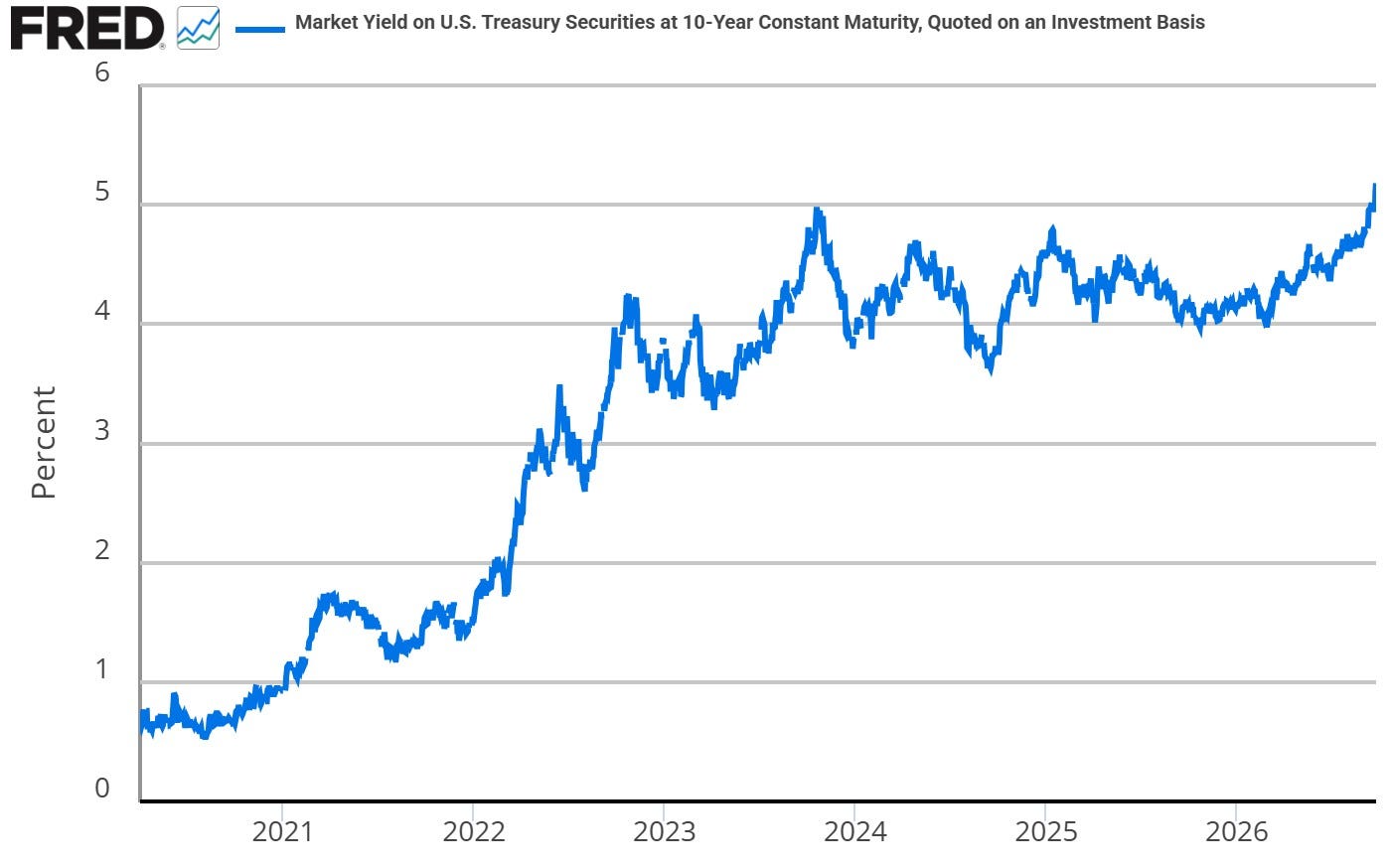
Figure 1 puts the recent move in long-term Treasury yields into perspective. When the pandemic hit in 2020, the Federal Reserve cut short-term interest rates to essentially zero, and longer-term Treasury yields also fell sharply. For much of 2020, the 10-year Treasury yielded less than 1 percent.
As inflation increased and the Fed raised short-term rates, markets revised upward their expectations for future interest rates and inflation. This caused long-term Treasury yields to rise sharply. By late-2022, the yield on 10-year Treasuries had risen to around 4 percent. This rapid rise in rates generated large capital losses for bondholders.
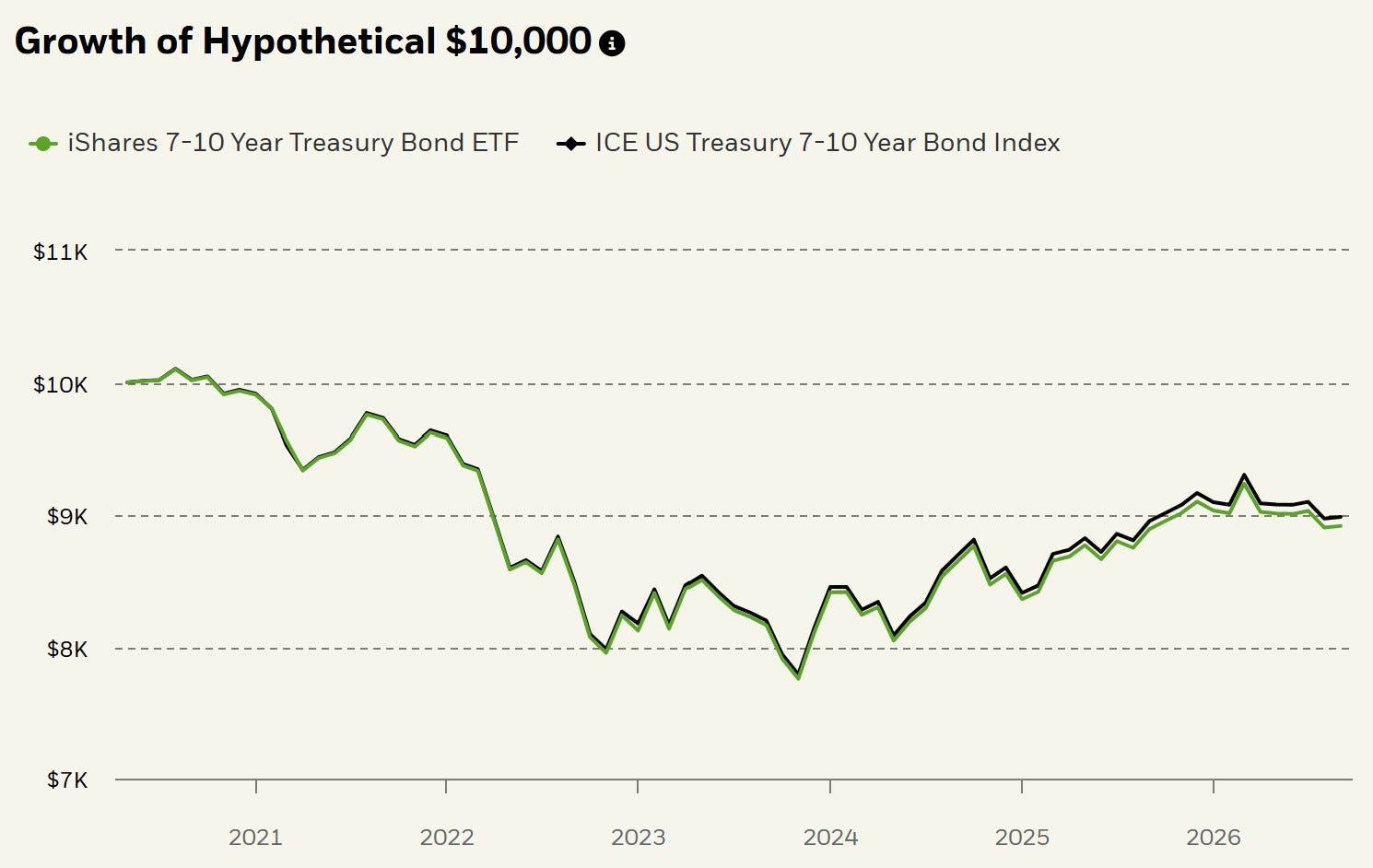
Figure 2 shows the growth of a hypothetical $10,000 investment in the iShares 7-10 Year Treasury Bond ETF, or IEF, beginning in 2020. An investor who put $10,000 into intermediate-term Treasury bonds near the beginning of this period saw the value of that investment fall sharply as interest rates rose. And even after the subsequent recovery as Treasury yields stabilized, the $10,000 initial investment remains well below its starting value.
This is an unusual outcome for a “safe” asset that many investors purchased as a hedge against stock market risk. It also helps explain why bond investors remain gun shy today. If rising rates caused this much damage last time, maybe bond investors are again in for a world of pain as long-term Treasury yields move higher.
Why Rising Rates Hurt Bond Prices
The basic mechanics are straightforward. A conventional Treasury bond promises a sequence of fixed coupon payments followed by repayment of principal at maturity. Its market price is the present discounted value of those future cash flows. When interest rates rise, the present discounted value of those future cash flows falls and, thus, so does the bond’s market price.
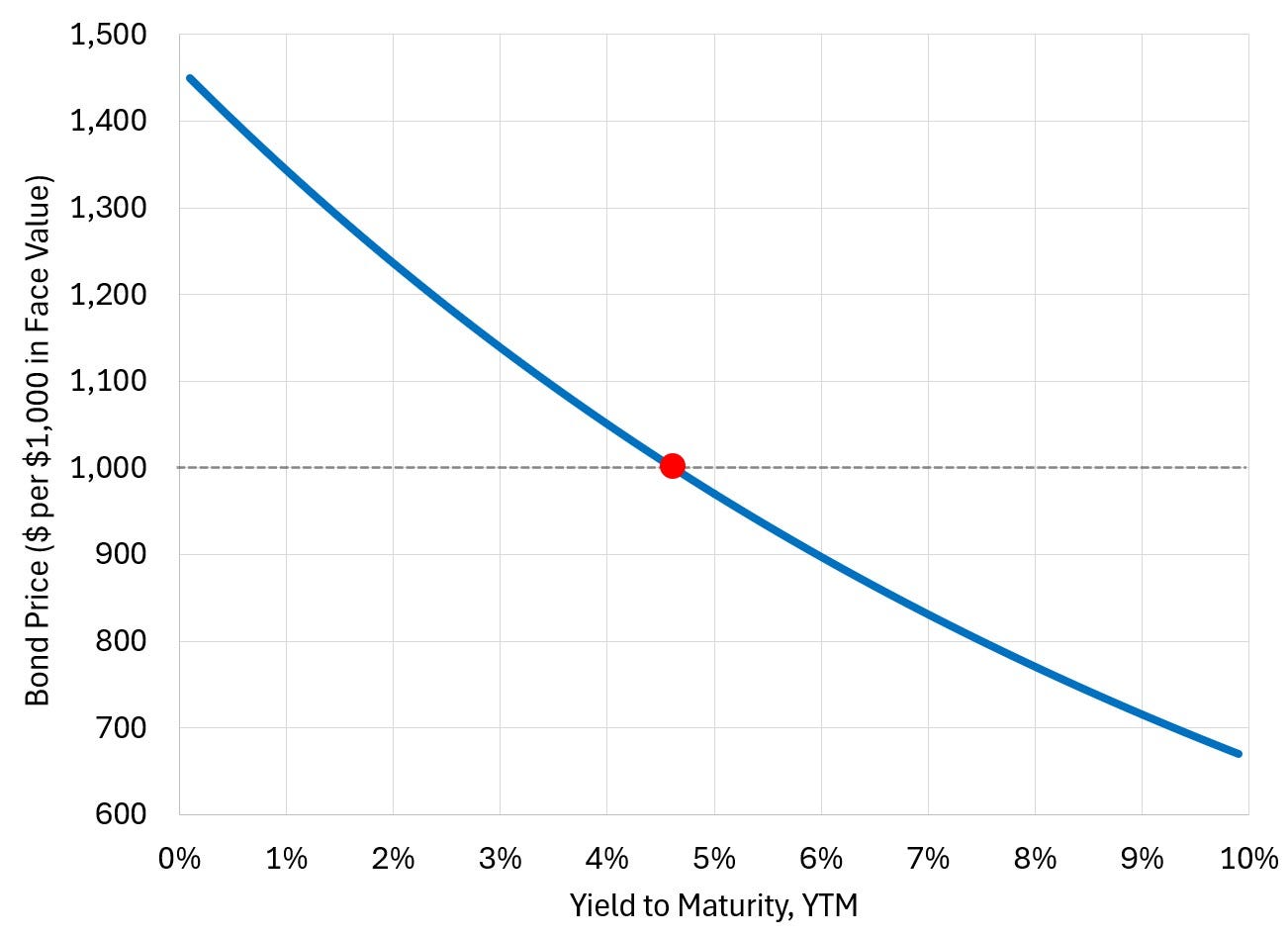
Figure 3 shows this relationship for a hypothetical 10-year Treasury bond with a $1,000 face value and a 4.625 percent coupon. The curve is downward-sloping precisely because as interest rates rise, the present value of the cash flows associated with the bond, and hence its market price, fall.
The curve is also convex. At lower yields, a given increase in rates produces a larger price decline than the same increase does at higher yields. This flattening reduces the capital loss associated with a given increase in rates.
Higher starting yields provide a second benefit, namely more coupon income to offset that loss.
The Benefits of a 5 Percent Coupon
Consider two investors who each purchase a newly issued 10-year Treasury at par. One buys when the prevailing yield is 1 percent and collects $10 a year in coupon income per $1,000 invested. The other buys at a 5 percent yield and collects $50 a year on the same $1,000. If rates subsequently rise, both bonds lose market value, but the latter has five times as much income to absorb that loss before the investor is left with a negative return.
Figure 4 shows the impact of the starting yield to maturity on the one-year total return. Each line represents a different starting yield assuming each bond trades at par. When rates do not change, the investor earns approximately the initial yield (i.e., just the coupon payments), so the three curves pass through returns of roughly 1, 3, and 5 percent when the change in yield is zero. As rates rise, capital losses pull returns downward. But higher starting yields provide a much larger cushion before these losses overwhelm the income generated by the bond’s coupon payments.
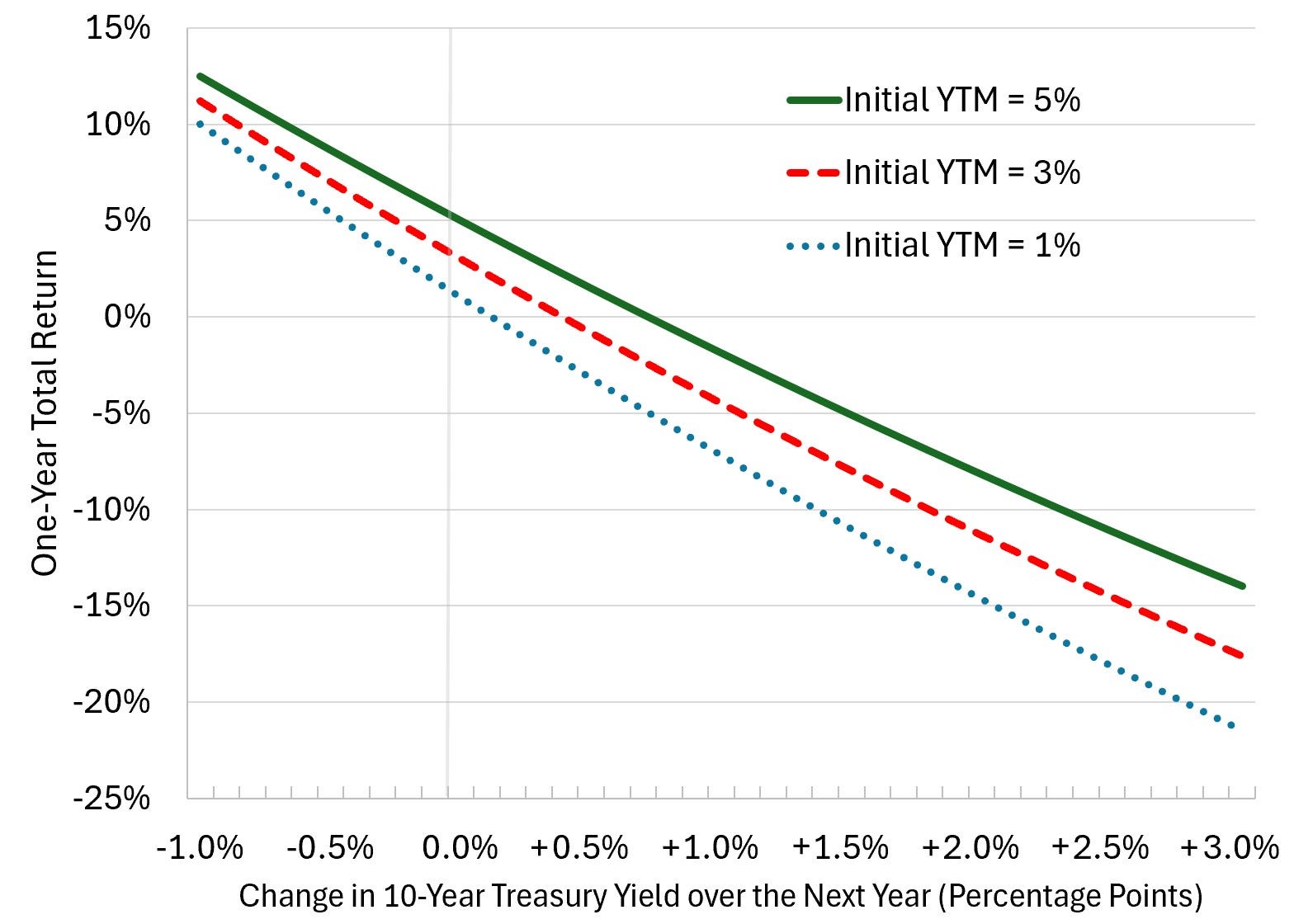
For an investor starting with a 1 percent yield, even a modest increase in rates produces a negative one-year return, and a 100-basis-point increase generates a loss of roughly 7 percent. Starting from a 5 percent yield produces a very different result. The same 100-basis-point increase still creates a capital loss, but the 5 percent coupon offsets most of it, leaving the one-year total return only modestly negative.
For an investor who buys 10-year Treasury bonds today with a yield in excess of 5 percent, interest rates can rise considerably more before the investor experiences losses comparable to those associated with the low-yield environment of 2020 and 2021.
Figure 4 also shows the other side of this tradeoff. Suppose the 10-year Treasury yield falls by 100 basis points. An investor who begins at a 5 percent yield receives the relatively high coupon payment and benefits from the increase in the market value of the bond. In this case the resulting one-year return is more than 12 percent.
Part of the difference between the upside and downside comes from the convexity of the bond price-yield relationship. A decline in rates produces a larger capital gain than the capital loss associated with an equally sized increase. But the much larger difference in total returns comes from the coupon income associated with the 5 percent starting yield, which the investor receives whether rates rise, fall, or remain unchanged.
What Could Go Wrong?
Treasury yields could continue to rise for one or more distinct reasons. Persistent inflation could push nominal rates higher. Real interest rates could rise independent of inflation, particularly if productivity growth accelerates. Investors could also demand a larger term premium (extra compensation for the uncertainty of holding long-duration debt) if they grow less confident in the Fed’s ability to anchor inflation expectations. Or large federal deficits and heavy Treasury issuance could push yields higher simply by increasing the supply of bonds the market needs to absorb.
As Figure 4 makes clear, a move from roughly 5 percent to 7 or 8 percent would generate meaningful losses for investors holding 10-year Treasuries, even with today’s higher coupon rates. While today’s higher starting yields provide more protection against rising rates, they are not a guarantee against loss.
Concluding Thoughts
The experience of the past several years provides a useful reminder that long-term Treasury bonds can generate substantial losses even in the absence of meaningful default risk. But the compensation investors receive for bearing duration risk has changed considerably. During the exceptionally low-yield environment of 2020 and 2021, investors accepted substantial interest-rate risk while receiving very little coupon income in return. At yields above 5 percent, investors now receive considerably more income to offset potential capital losses if rates continue to rise.
For an investor deciding whether to add longer-duration Treasuries today, the relevant comparison is between the income available at today’s yields and the range of potential returns associated with future movements in rates. A moderate increase in yields produces much smaller losses from today’s starting point, while a decline in rates combines relatively high coupon income with the potential for sizable capital gains. This is precisely what makes the long-term Treasury market considerably more attractive today than it was in the wake of the pandemic.
If you enjoyed this mildly efficient and occasionally rational take on the recent rise in Treasury yields, consider subscribing below. We’ll keep exploring markets and models, uncovering mildly surprising truths along the way.
No hot takes; just thoughtful ones.

About the Author: Seth Neumuller is an Associate Professor of Economics at Wellesley College where he teaches and conducts research in macroeconomics and finance. He holds a Ph.D. in economics from UCLA. His Substack is Mildly Efficient (and Occasionally Rational) where he explores topics in finance and macro from first principles, cutting through complexity with clear, grounded analysis.
Notes and Sources
AI tools were used for proofreading and language editing.