

There has been increasing discussion about whether the Federal Reserve needs to raise interest rates further to keep inflation from becoming more persistent. Markets continue to price in the possibility of another hike this year, while the median projection in the Fed’s September Summary of Economic Projections implies one additional 25-basis-point increase by year-end.
I remain skeptical. My own view is that much of the recent increase in inflation reflects supply shocks, with relatively little reason to expect those price increases to spread throughout the economy (in the absence, of course, of easing monetary policy).
But suppose that concern is warranted. Suppose real economic growth is above potential and there is a need to slow aggregate demand to prevent inflationary pressures from taking hold.
Even in this case, the Fed may not need to raise rates further. The bond market appears to already be doing much of the Fed’s work.
The Fed directly controls short-term interest rates, specifically the federal funds rate, which is the rate at which depository institutions lend reserve balances to one another overnight. Following its September meeting, the target range for the federal funds rate is now 3.75 to 4 percent.
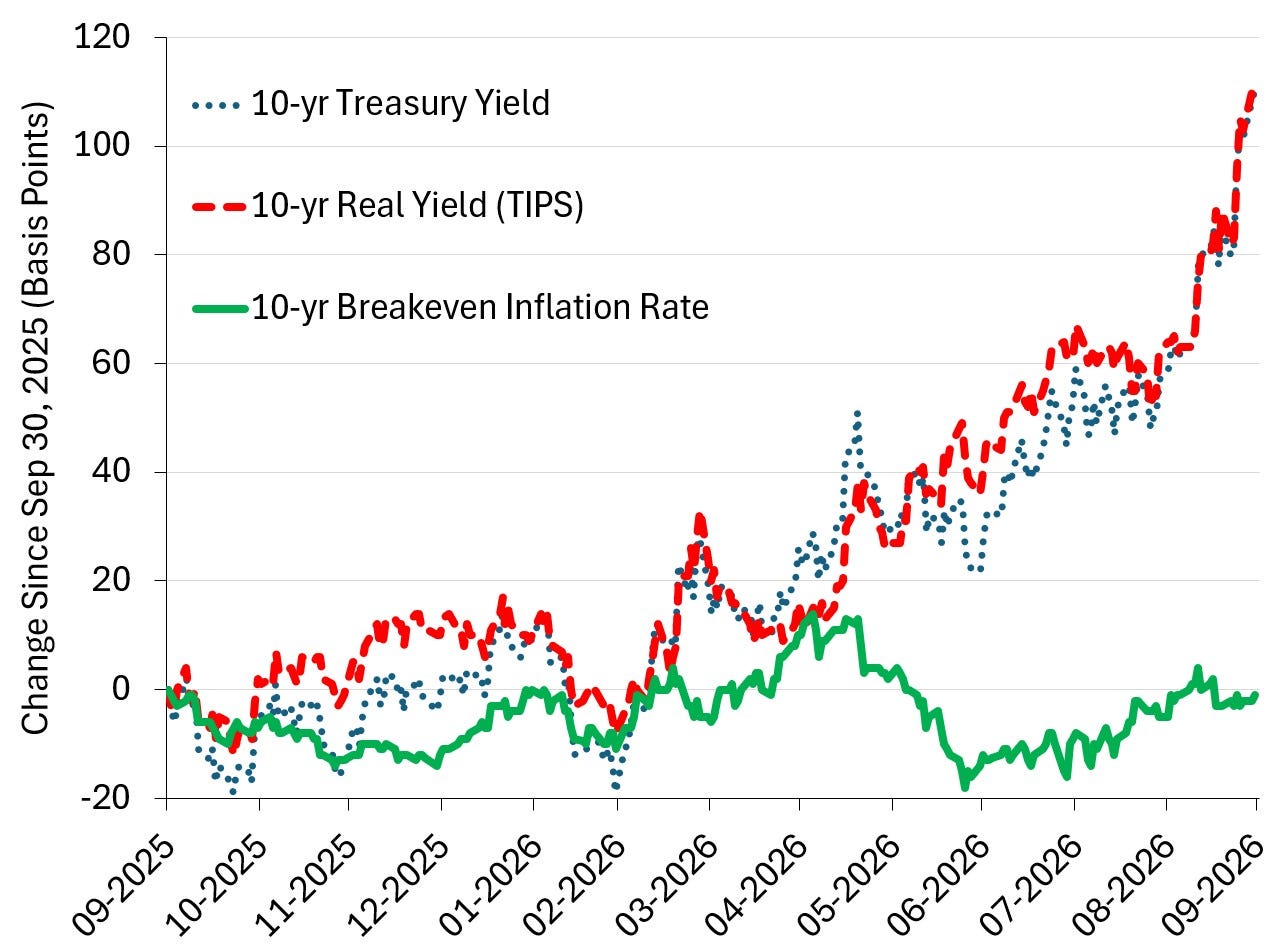
But the spending decisions policymakers ultimately want to influence depend on longer-term rates. And those rates have risen substantially over the course of the last year, and especially over the last month or so. For example, the 10-year Treasury yield increased from under 4 percent back in September 2025 to more than 5.2 percent by the end of September 2026.
More importantly, almost all of that increase appears to reflect higher real interest rates rather than compensation for higher expected inflation, as shown in Figure 1.
One of the most important drivers of economic growth recently has been the AI data center buildout, and the spending plans of the hyperscalers suggest this trend is set to continue. Microsoft expects roughly $175 billion of capital expenditures during calendar year 2026. Amazon expects about $220 billion. Meta expects between $130 billion and $145 billion, while Alphabet expects between $195 billion and $205 billion. Taken together, those four companies alone plan to invest roughly $720 billion to $745 billion this year. Oracle, meanwhile, expects capital expenditures of roughly $90 billion to $95 billion during its 2027 fiscal year. Across the five firms, planned capital expenditures exceed $800 billion.
At several of these firms, capital expenditures now exceed internally generated free cash flow, increasing the importance of outside financing. To this end, Amazon has issued roughly $97 billion of public debt so far this year123, Meta has raised $25 billion, Alphabet has raised nearly $77 billion45, and Oracle has raised $25 billion in debt. Taken together, these four firms have raised more than $220 billion in public debt this year.
This is where the recent rise in long-term Treasury yields begins to bite.
Corporate borrowers pay the long-term Treasury rate plus a credit spread. As Figure 2 shows, debt from AI-related issuers (e.g., Meta, Oracle, etc.) is also trading at wider spreads than the broader investment-grade market.
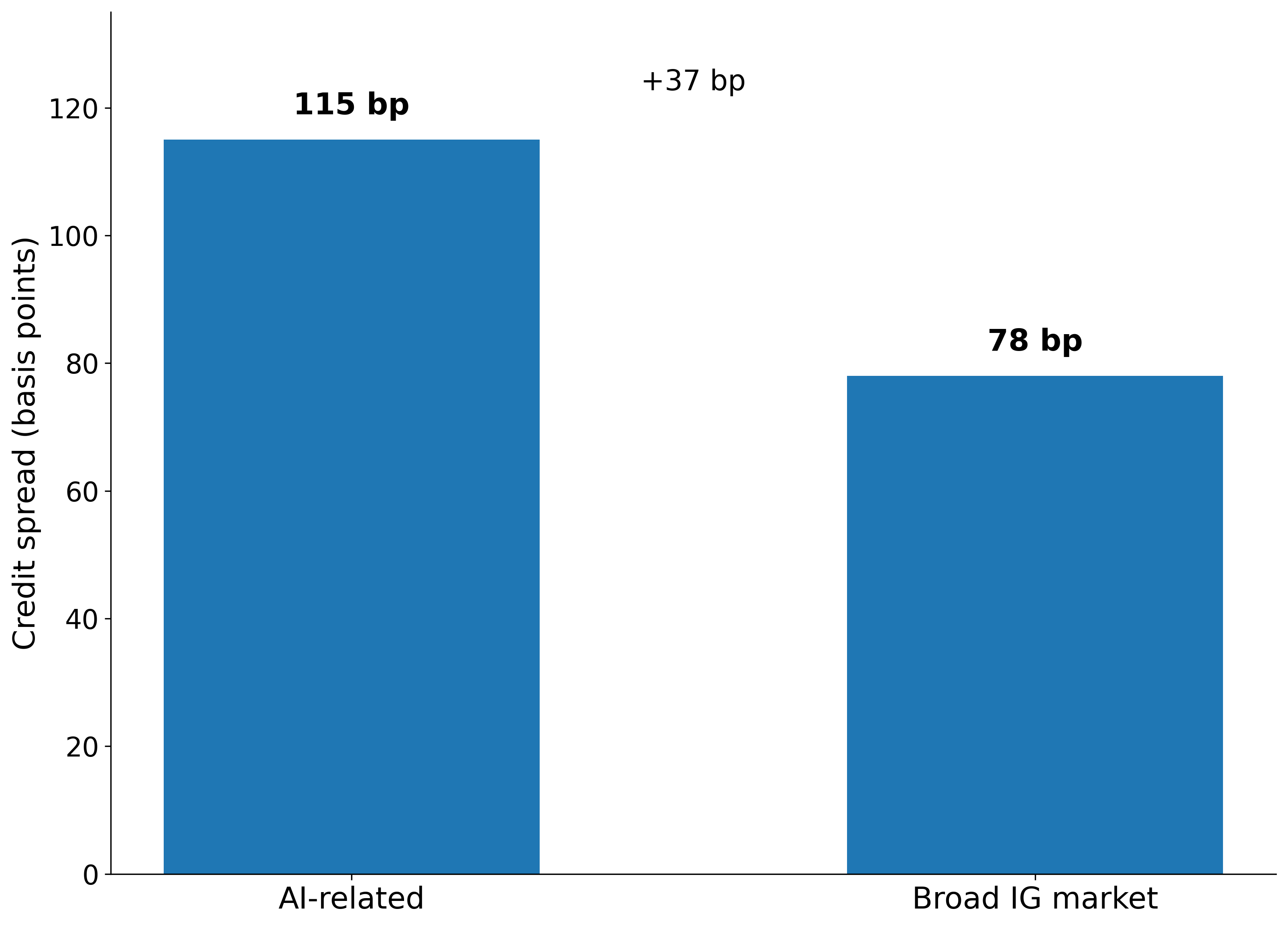
The costs of financing new AI investment are thus elevated for two distinct reasons. Real Treasury yields have moved sharply higher, while AI-related issuers face wider spreads than the broader investment-grade market.
Higher financing costs are not going to bring the data center buildout to a screeching halt. Projects already under way have generally secured financing, and new investments may remain attractive even at today’s considerably higher funding rates. But the required return for the marginal AI project has increased.
That is precisely the kind of response tighter monetary policy is intended to produce. Only this time, much of the tightening is already showing up in long-term market rates.
If policymakers are worried that unusually strong AI investment is adding demand to an economy already facing supply constraints, higher long-term rates will serve as an increasingly strong headwind.
Another 25-basis-point increase in the federal funds rate would further tighten financial conditions broadly across the economy. But the roughly 120-basis-point rise in the 10-year Treasury yield over the past year, combined with wider spreads for AI-related debt, has already significantly raised the cost of capital for the firms at the center of the AI investment boom.
Before concluding that the Fed needs to raise short-term rates further, it is worth recognizing that higher long-term yields are already doing some of that work by raising the cost of financing the AI buildout.
If you enjoyed this mildly efficient and occasionally rational take on how the bond market is already doing much of the Fed’s work, consider subscribing below. We’ll keep exploring markets and models, uncovering mildly surprising truths along the way.
No hot takes; just thoughtful ones.

About the Author: Seth Neumuller is an Associate Professor of Economics at Wellesley College where he teaches and conducts research in macroeconomics and finance. He holds a Ph.D. in economics from UCLA. His Substack is Mildly Efficient (and Occasionally Rational) where he explores topics in finance and macro from first principles, cutting through complexity with clear, grounded analysis.
Notes and Sources
AI tools were used for proofreading and language editing.
https://www.sec.gov/Archives/edgar/data/1018724/000101872426000026/amzn-20260630.htm
https://www.sec.gov/Archives/edgar/data/1018724/000110465926082293/tm2619352d4_8k.htm
https://www.sec.gov/Archives/edgar/data/1018724/000110465926107526/tm2624614d5_8k.htm
https://www.sec.gov/Archives/edgar/data/1652044/000165204426000071/goog-20260630.htm
https://www.sec.gov/Archives/edgar/data/1652044/000119312526342390/d171253d8k.htm