

I recently listened to a Blister Podcast Book Club episode in which Jonathan Ellsworth spoke with writer George Sibley about his book, Dragons in Paradise. I picked up a copy of Sibley’s book because I wanted to learn more about mountain towns from the perspective of someone who has lived in one for most of his adult life.
Sibley arrived in Crested Butte in the 1960s, worked on the ski patrol at the town’s struggling young resort, later bought and ran the local newspaper, and has spent much of the past six decades writing about mountain communities and the complicated relationship between people, money, and place.
My own relationship with these places is much less intimate. I have never lived in a mountain town. I grew up in the suburbs of Southern California and skied with my family for just a week or two each year at Mammoth Mountain, back in the days when their only high speed lift was the Broadway Express (Chair 1). I have so many fond memories of growing up skiing there. It was one of the highlights of my childhood.
Having since moved to the East Coast for work, I now have a family of my own. These days I spend much of the winter trying to pass the enthusiasm for skiing I developed as a kid along to my daughters. Some of my favorite days have been spent skiing with them. Although I also quite enjoy getting out there on my own, chatting with people in the lift lines, and trying to improve my Carv score.
Living in the Northeast probably makes skiing more important to me than it otherwise would be. Winter can grind on for months if you spend the entire season waiting for spring. Having an outdoor winter pastime changes the calculus. A forecast for snow becomes something to look forward to rather than something to dread.
My skiing these days is not exclusively lift-served. Wachusett, my local mountain, permits uphill travel before the lifts open, and I enjoy skinning up in the morning when family life permits, which is admittedly less often than I would like with young kids at home. I have no experience with serious backcountry skiing or ski mountaineering, though. Most of the skiing I grew up doing, and almost all of the skiing I now do with my daughters, is lift-served.
That distinction kept coming back to me while reading Sibley’s book, particularly when he writes about the “dragons” that arrive in mountain communities.
Sibley’s dragons are reptilian in nature and respond instinctively to the scent of profit, destroying anything that gets in their way. They need not intend to damage the community they descend upon. They simply follow the money because that is what, in Sibley’s view, dragons do.
Sibley’s own description of Crested Butte’s evolution is revealing. After the resort’s early financial troubles, he and others briefly entertained the idea that greater civilization might have abandoned the valley. He later concluded that “civilization never abandons anything that has any remote possibility of profitability.” Capital might retreat, but if an opportunity remains, dragons will eventually come to exploit it.
The consequences are familiar to anyone who spends time in economically vibrant mountain towns today. A desirable mountain town is discovered by the masses. Money follows. Housing becomes more expensive, big box stores move in displacing local establishments, and some of the people who helped create the culture that made the town desirable in the first place eventually struggle to afford to stay.
In his writing, Sibley also captures another familiar tendency among newcomers. Once we have “discovered” a desirable place and made it our home, we often, as Sibley puts it, “want the building to stop,” leaving the town roughly as we discovered it. I understand the impulse. Development can consume some of the amenities that made the town desirable in the first place.
Historian Hal Rothman describes tourism development in the twentieth-century American West as a devil’s bargain. Tourism can provide a new economic foundation for communities whose traditional industries were disappearing, sometimes helping revive towns with few obvious alternatives. But success also shifts wealth and influence toward outsiders and, as a result, has transformed many of the places it helped save.1
What I think has yet to be highlighted in this ongoing conversation is the dynamic nature of this bargain. Building a ski resort does not simply require a one-time investment. A chairlift is installed, but it must be maintained and eventually replaced. Snowmaking systems age. Groomers wear out. Lodges deteriorate. The capital that supports lift-served skiing has to be renewed, repeatedly and indefinitely.
While reading Sibley’s book, I kept coming back to the same question: What would Paradise look like if the dragons never came?
Before Paradise
Looking at Crested Butte today, it is easy to imagine that the alternative to development was an earlier version of the same place, but with cheaper housing, fewer tourists, and roughly the same small tight-knit community residing beneath the same spectacular mountain.
History suggests another possibility.
Crested Butte began as a mining town. When mining declined, so did the economic foundation that supported the community. The town’s population fell from roughly 1,250 in 1930 to only 259 by 1960, and children in sixth through twelfth grades were required to travel roughly 30 miles to Gunnison to attend school.
Andy Eflin, whose father Dick helped found the resort, later described pre-resort Crested Butte as a place where there “wasn’t a whole lot going on” economically and where it was difficult for people to support themselves. The development of the ski area in the 1960s is widely viewed as the beginning of the town’s revival, providing an opportunity for the town to reinvent itself.
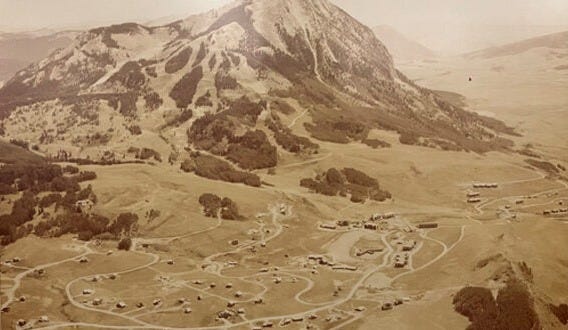
I found Sibley’s description of this transition particularly insightful. The valley moved toward what he calls the “mountain-experience industry,” with residents increasingly earning their living by providing services to tourists instead of extracting a physical commodity and shipping it elsewhere.2
There is a tendency to think of a service-based economy as somehow less capital intensive than an old industrial economy. Lift-served skiing is a good reminder that this is not always the case. It requires expensive, capital-intensive machinery to produce lift-served skiing services.
The Crested Butte ski area opened in 1961, but its early years were financially difficult. One of the founders’ business partners went bankrupt in the late 1960s, and the resort went through financial reorganization before reopening again just as Sibley moved to town. Then Howard “Bo” Callaway and Ralph Walton acquired the resort in 1970 and spent the following decades investing in it.
Without that investment, the ski resort may have continued to struggle financially. Perhaps a smaller community would have survived though, built around ranching, art, and human-powered recreation. It might have been a wonderful place. But would there have been enough employment for families who wanted to stay? Would the town have regained the services, like schools and healthcare, that population loss had made difficult to sustain? Would Crested Butte Mountain Resort even exist today if the dragons never came?
Keeping the Lifts Turning
I have been thinking about these questions in part because I have recently fallen down another ski-related rabbit hole: New England’s lost ski areas.
There are hundreds of them. Once you start looking, their remains seem to appear everywhere. An opening in the woods turns out to be an old ski trail. A rusting piece of machinery was once part of a lift.
Beartown Mountain in western Massachusetts is one of my favorite examples. A few years ago, I joined an Appalachian Mountain Club outing to help maintain some of Beartown’s old ski trails. Lift-served skiing at Beartown ended decades ago, but a small community of skiers was putting in the work required to make portions of it skiable again, albeit under human power only.
Hiking around Beartown, I could imagine what it must have been like decades before. The Civilian Conservation Corps (CCC) began developing the area in the 1930s, deliberately locating the trails beside the railroad to take advantage of the emerging snow-train business. In fact, Beartown was served by the South Lee railway station immediately beside the ski area.
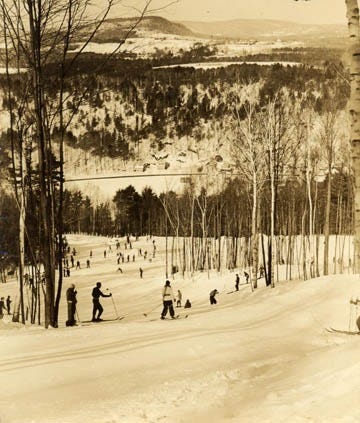
There is something remarkable about that image today. A skier could board a train in Manhattan, travel into the Berkshires, spend the day skiing, and walk back to the station for a train ride home at the end of the day.
By 1941, public spending on the development had reached about $65,000, including a lodge and a long rope tow. After World War II, the area expanded again, and by the early 1950s three rope tows served roughly 820 vertical feet of ski trails, making Beartown one of the larger lift-served ski areas in southern New England.
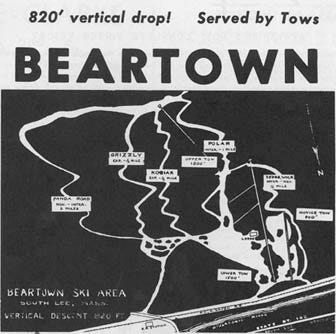
Then the economics shifted. The snow trains disappeared as the interstate highway was developed and cars became the dominant way skiers reached mountains. But Beartown only had parking for a handful of vehicles. Natural snowfall was unreliable. Nearby competitors invested in chairlifts and other infrastructure improvements. In the 1960s Beartown got a new access road and new rope tows, but visitation remained light. By 1964, operator William McCormack argued that Beartown was too much mountain for rope tows, and reopening would require enough capital for a chairlift or T-bar reaching the summit. A $1.5 million redevelopment plan was proposed two years later, which included a chairlift, two T-bars, and condos near the base area.
It never happened. And Beartown has been closed ever since.
Recently, local skiers started clearing and maintaining the original CCC ski trails. The Western Massachusetts Backcountry Alliance now works with the Massachusetts Department of Conservation and Recreation to maintain Beartown as an entirely human-powered ski zone.
In this sense, Paradise survived.
On the right day, after enough snow has accumulated, locals can climb through the woods and make turns on the old CCC ski trails. There is something quite appealing about this current manifestation of Beartown Ski Area.
But it is a vastly different product from the one Beartown Ski Area once offered. A lift-served Beartown Ski Area today would have required considerably more capital investment, and eventually nobody was willing or able to provide enough of it. The dragons never came.
Beartown is not unique. Dutch Hill, just across the Massachusetts border in southern Vermont, followed a remarkably similar path. A popular midsized ski area from the 1940s through the mid-1980s, Dutch Hill eventually operated a T-bar, J-bar, and rope tow across roughly 570 vertical feet.
Like Beartown, it struggled as the ski industry changed around it. Larger competitors invested, Dutch Hill remained dependent on natural snowfall, and the lifts stopped running permanently after the 1984-85 season.
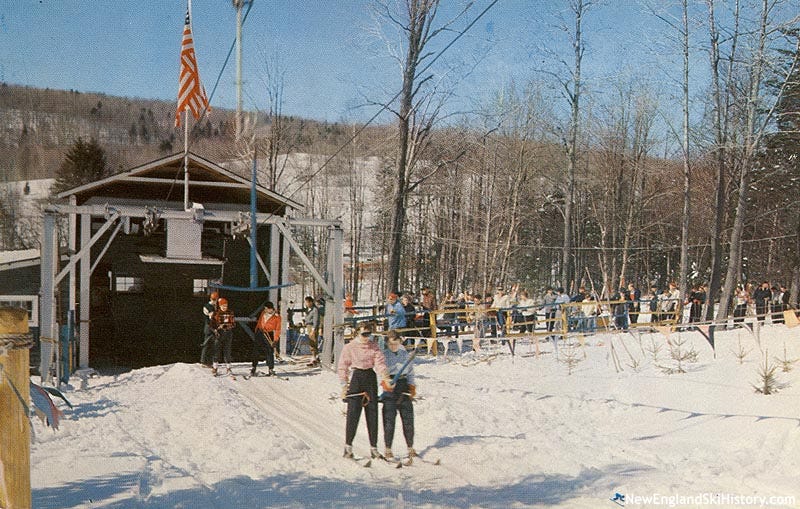
Decades later, volunteers working with the Forest Service began clearing its former trails, and today the old ski area is once again skiable when natural snowfall cooperates, entirely under human power.
Dutch Hill and Beartown ended up in remarkably similar places: the commercial ski areas disappeared, but versions of Paradise survived.
Wachusett Mountain
The comparison that comes naturally to me is Wachusett Mountain in Princeton, MA.
Wachusett has been my home mountain since I moved to Massachusetts for work about fifteen years ago. I have skied there alone, with friends, and with my family. My daughters learned to ski there and developed the skills that eventually allowed us to venture off and visit larger mountains elsewhere in New England. I hope they grow up with the same kind of memories of learning to ski at Wachusett that I have from skiing with my own family at Mammoth Mountain during my youth.
From today’s perspective, Wachusett looks like an obvious place for a successful ski resort. It sits within about an hour’s drive of Boston and Worcester, has night skiing and extensive snowmaking, a racing program and a thriving ski school, and can attract people who want to ski without spending hours in the car.
But it was not an obvious success story from the start. Like Beartown, the original trails were cut by the CCC in the 1930s. The state tried to develop the ski area in the early 1960s, but struggled mightily. The mountain itself has limitations. Wachusett is only a little over 2,000 feet high, with roughly 1,000 feet of skiable vertical, and its location within a state reservation constrains expansion. Its advantage was access to a large urban population, but converting that advantage into a successful ski operation would require significant investment.
In 1969 Wachusett Mountain Associates, led by Ralph Crowley and Normand Letarte, won a five-year operating contract from the state for just $16,002, a clear sign that success was far from inevitable. In 1977, the Massachusetts legislature authorized a thirty-year renewable lease for the ski area. After years of debate and environmental review, the longer-term arrangement helped set the stage for significant capital investments, including a $7 million expansion beginning in 1982 that added chairlifts, summit skiing, a larger base lodge, and improved snowmaking.
The Crowley family complicates Sibley’s dragon metaphor. Ralph Crowley certainly invested with the intention of making money. Yet the family stayed. His children became involved in operating the resort, and the family remains hands-on at Wachusett decades later. Their presence makes Wachusett feel different from a resort owned and operated remotely as one asset in a much larger portfolio. Owners who expect to operate a mountain across generations and regularly encounter customers have reasons to care about the long-run condition of the place that may differ from those of an investor with a shorter time horizon and weaker ties to the community.
Different Types of Dragons
Black Mountain in Jackson, New Hampshire, is another interesting example. Skiing there dates back to 1935. Today it remains a relatively small independent area with about 1,100 feet of vertical in the Mount Washington Valley, surrounded by much larger competitors (like Attitash, Wildcat, and Bretton Woods).
In 2023, longtime owners announced that they could not open for the coming season due to a combination of soaring energy costs, unpredictable weather, and staffing shortages. Indy Pass parent company Entabeni Systems stepped in with financial and operational support, and in 2024 it purchased the ski area. Erik Mogensen moved to Jackson to run Black personally, initially with a plan to transfer the mountain to a community cooperative. But then in early 2026, after operating it for more than a season, he instead decided to retain ownership.
By Sibley’s broad framing, an outsider arriving with money to acquire a mountain sounds suspiciously dragon-like. Yet in this case the capital arrived because the alternative was the possible loss of an independent ski area.
Mogensen has explicitly described Black as a place to experiment with ways of keeping independent skiing viable in the face of rising costs, aging infrastructure, and competition from much larger resorts.
Whether the model ultimately succeeds remains to be seen. But this uncertainty is part of the point. Someone still has to bear the risk of making the next investment.
Buying the Mountain Back
There is another increasingly appealing response to dragons in paradise: put control of the mountain back into the hands of people who actually live and ski there.
Mad River Glen provides the classic example. Its cooperative was created in 1995 so loyal skiers could purchase the mountain and preserve its unique skiing experience. The cooperative eventually paid off its acquisition debt and has continued reinvesting in the mountain’s infrastructure.
Killington provides a more recent example. In 2024, a group led by local homeowners and longtime skiers purchased Killington and Pico from POWDR. The new owners explicitly committed to local, independent ownership and continued capital investment.
There is an interesting tension here. Local ownership may change who makes decisions and what objectives receive weight, which can matter enormously. But the community buying back a resort is not starting with an untouched mountain. It is buying lifts, snowmaking, lodges, roads, parking, trails, permits, and a customer base built through decades of previous investment. In that sense, buying Paradise back often means buying the capital dragons invested in development in the first place.
The need for continued reinvestment also doesn’t end after the acquisition. Lifts still wear out. Employees still have to be paid. Snowmaking still requires electricity. A locally controlled mountain that wants to keep lift prices affordable may still need more paying customers than the town and its surrounding population can supply.
Community ownership changes the objective function. It does not eliminate the need for continued investment and the capital to support it.
Wanting It All
This brings me back to the difference between Sibley’s experience in the mountains and my own.
For someone who primarily values human-powered skiing, more resort development can reduce the value of what the mountain has to offer. More infrastructure means less solitude.
I understand the appeal. On mornings when I skin up Wachusett before the lifts open, the mountain feels different. It is quieter, the pace is slower, and getting a few laps in (usually on Ralph’s Run) under my own power is incredibly satisfying.
I am also very happy when the lifts start spinning and I am able to ski with my kids.
Those of us who enjoy mountain towns have a remarkable tendency to want all of the benefits generated by a successful recreation economy while preserving the characteristics that existed before success arrived. We want fast and reliable lifts and extensive snowmaking capabilities without expensive lift tickets, uncrowded trails but enough skiers to keep the resort financially viable, living wages and affordable housing for employees, and economic opportunity for the children who grow up there.
The problem is not that any one of these desires is unreasonable. Most are perfectly reasonable in isolation. The problem is that the economics connecting them make it difficult to have all of them at once. More customers make investment easier to finance but create crowds. Higher wages make local jobs more sustainable for workers but raise operating costs. New housing can ease scarcity while changing the physical character of the town.
The Counterfactual We Don’t See
The appeal of Sibley’s critique is that the costs of development are visible. We can see the new condos, increased traffic, higher house prices, and big box retailers. We can remember what the town looked like before the latest round of investment and identify what was lost.
The costs of insufficient investment are much harder to see because they consist largely of things that never happen: the lift that is not replaced, the restaurant that never opens, or the job that never materializes.
The absence of another round of investment at Beartown and Dutch Hill produced mountains that today offer a wonderful human-powered skiing experience to a small number of skiers when natural snowfall cooperates.
When we ask whether the dragons made things worse, the alternative cannot simply be the successful town or resort we observe today with the objectionable development subtracted from it. The comparison is between different paths through time, each of which changes the place in its own way.
Back to Crested Butte
Crested Butte’s later history brings the two sides together.
After Callaway and Walton, the Mueller family acquired the resort and invested in lifts, snowmaking, grooming equipment, and real estate. In 2018, Vail Resorts acquired Crested Butte along with the Muellers’ Okemo and Mount Sunapee operations.
Vail is much closer to the dragon most people probably picture: a large publicly traded resort company arriving in a fiercely independent mountain town with substantial financial resources and obligations to shareholders.
Yet reporting in 2019 found that much of Crested Butte’s lift infrastructure was in poor condition. The 39-year-old Teocalli chair was closed, other lifts were experiencing problems, and most of Vail’s initial investment went toward rehabilitating basic infrastructure rather than expansion.
This is exactly the dynamic problem that makes the counterfactual difficult to envision. The capital invested decades earlier did not remain adequate forever. Even after Crested Butte had successfully transformed itself into a ski destination, another round of investment eventually became necessary to (literally) keep the lifts spinning.
Corporate ownership can commercialize and crowd a mountain in ways that longtime residents dislike. But corporate ownership can simultaneously possess the financial capacity to replace equipment that an independent operator struggled to finance.
Both things can be true.
The Economics of Paradise
As mountain town residents know all too well, outside investors do not automatically bear all of the costs their investments create. A resort expansion can generate revenue for its owner while increasing traffic for everyone else. New visitors support businesses while bidding up housing prices. A resident can become wealthier according to the value of their home while becoming poorer according to many of the characteristics that made living there appealing in the first place.
There is no reason to expect a profit-seeking outside developer to assign those losses the same weight as the people who experience them. This is where Sibley’s dragon metaphor has real bite. The dragon does not need to dislike the community. It simply responds strongly to the things that enter its own objective function and weakly, if at all, to those that do not.
But preservation has a related problem. Existing residents understandably put great weight on preserving the community they already know. Future residents do not vote in today’s planning meetings. Neither does the child who may eventually leave because there are too few opportunities to build a career locally, or the entrepreneur whose business never opens because the customer base never becomes large enough.
Markets can generate too much development when investors do not bear all of its costs. But local politics can generate too little when existing residents do not bear all of the costs of preventing it. There are externalities on both sides.
That is ultimately the counterfactual I think Sibley’s dragons force us to confront.
The costs of development are real. Resort expansion can raise housing costs, increase congestion, change local culture, and transfer control to outside investors whose interests are not perfectly aligned with those of the community. Sibley is right to make us take those costs seriously.
But evaluating the dragons requires comparing that outcome with the right alternative. For a capital-intensive activity like lift-served skiing, “no dragons” isn’t a stable, frozen version of Paradise. Without someone financing the next round of capital investments, the mountain won’t stay as it was; it will change.
Beartown and Dutch Hill ski mountains still exist and a quieter form of Paradise has returned. But lift-served skiing disappeared.
At Wachusett, repeated investment by a committed family has kept a modest mountain economically viable and turned it into a place where generations of families could continue learning to ski, honing their skills, and enjoying the outdoors.
Crested Butte sits between those examples, repeatedly requiring capital infusions even as each wave of investment created some of the problems Sibley rightly points out.
For mountain towns organized around lift-served skiing, a flow of capital is unavoidable if the resort is to survive. The question is how to structure ownership, property rights, and local institutions so that the people providing that capital have reason to care about what remains after they earn their return.
I started reading Dragons in Paradise because I wanted to understand mountain towns from the perspective of someone who has spent a lifetime thinking about them from a position very different from my own. Sibley succeeded in making me more skeptical of the idea that economic growth is an unambiguous measure of improvement. A sense of place, local relationships, history, and the peculiarities that distinguish one mountain town from another are important too. Losing them is a real economic loss.
But the lost ski areas of New England have made me skeptical of treating non-development as the obvious answer.
There is no way to freeze a mountain town at the moment we happen to fall in love with it. Capital can change a place, sometimes leaving it wealthier but less recognizable. But the absence of capital can change it too, sometimes by slowly eliminating the economic activity that allowed the community, or the ski area around which it grew, to persist.
Sibley’s dragons taught me to worry about what happens when profit-seeking capitalists come to Paradise.
But Dragons in Paradise also made me worry just as much about what happens if the next round of investment never comes.
If you enjoyed this mildly efficient and occasionally rational take on George Sibley’s Dragons in Paradise, consider subscribing below. We’ll keep exploring markets and models, uncovering mildly surprising truths along the way.
No hot takes; just thoughtful ones.

About the Author: Seth Neumuller is an Associate Professor of Economics at Wellesley College where he teaches and conducts research in macroeconomics and finance. He holds a Ph.D. in economics from UCLA. His Substack is Mildly Efficient (and Occasionally Rational) where he explores topics in finance and macro from first principles, cutting through complexity with clear, grounded analysis.
Notes and Sources
AI tools were used for proofreading, language editing, and identifying relevant sources and citations.
Footnotes
Hal K. Rothman, Devil’s Bargains: Tourism in the Twentieth-Century American West (University Press of Kansas, 1998). Rothman documents the transformation of Western communities through tourism, emphasizing both its ability to provide a new economic foundation after traditional industries declined and the resulting changes in local control, culture, and the distribution of economic benefits.
This transition has a direct parallel in the economics literature on amenity-based development. Silberman and Rees study former mining and ranching settlements in the Rocky Mountains that seek to reinvent themselves as ski towns after the industries that originally supported them decline. They emphasize that ski development can revive local economies while also creating environmental pressures, housing shortages, and strains on local services. More broadly, the amenities literature finds that natural amenities can attract migration and economic activity to rural areas. See Jordan A. Silberman and Peter W. Rees, “Reinventing Mountain Settlements: A GIS Model for Identifying Possible Ski Towns in the U.S. Rocky Mountains,” Applied Geography 30, no. 1 (2010): 36–49; and Brian E. Garber-Yonts, The Economics of Amenities and Migration in the Pacific Northwest, USDA Forest Service General Technical Report PNW-GTR-617 (2004).
Really interesting! So many dimensions with interacting influences on sustainable economic viability of these businesses.